News Bureau Features INHS-MEL Member Lance Jones

Hundreds of ticks cross Lance Jones’ desk each year, each one a small but important piece of Illinois’ public health puzzle.

In this behind-the-scenes feature, Lance shares how detailed morphological work, DNA barcoding, and field surveillance come together to identify ticks submitted from across Illinois. With more than 1,000 ticks sent in by the public in 2025 alone, accurate identification is essential to understanding which pathogens may be present, including those responsible for Lyme disease and Rocky Mountain spotted fever.

From permethrin-treated field gear to the careful positioning of specimens under a stereomicroscope, Lance’s work helps build a clearer picture of tick distribution and disease risk in our state.

Read the full story to learn how Lance’s research supports public health across Illinois.

Photo by Fred Zwicky.

New BiteMap website

We have launched the BiteMap website in collaboration with colleagues at the University of Illinois Urbana-Champaign’s National Center for Supercomputing Applications to enhance our community-engaged passive tick surveillance program and collaborations, including with Lincoln Park Zoo and IL Extension. The website allows Illinois residents to report tick bites and encounters, and initiate submissions of tick specimens to our lab for identification, and data will be displayed at the zip code level on an interactive map. A subset of ticks will be tested for pathogens.

Now hiring hourly positions in Public Health Entomology 2022

Our advertisement for seasonal hourly technicians is now open! Deadline for full consideration is April 1, 2022.

Please see announcement at the INHS website.

The work is diverse and provides great field and lab experience. Positions will be focused on one or a combo of: field collections of mosquitoes & ticks, pathogen testing, and organismal lab experiments. We are seeking undergraduate or recently graduated hourly technicians during April-November to work on mosquito and tick surveillance and field experiments. The positions are based at the Illinois Natural History Survey Medical Entomology Lab, within the University Research Park. Applicants should be available part or full-time Monday through Friday. For more information contact Lab Director Dr. Chris Stone by e-mail.

We will also be announcing two salaried research positions very soon. Check back or reach out for details.
Lone Star ticks in Illinois can carry, transmit Heartland virus

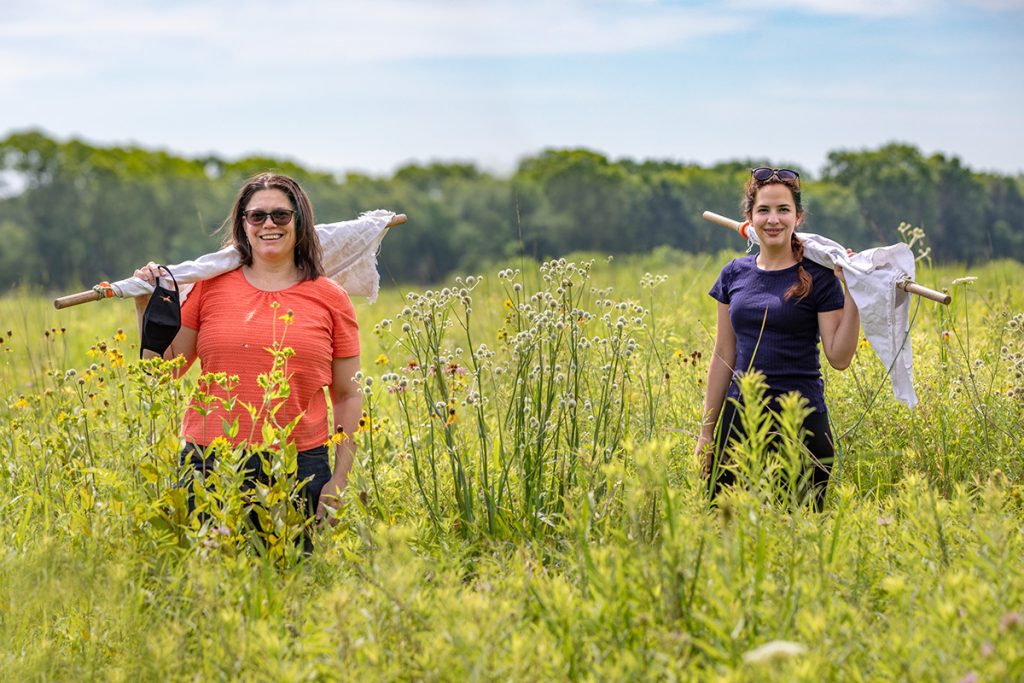
Dr. Holly Tuten, who is a vector ecologist with the Illinois Natural History Survey, says she specializes in the study of spineless blood suckers such as ticks and tick-borne disease agents. Her current work with Erica Hernandez, right, looks at the Heartland Virus, a serious tick-borne virus that is now spreading into Illinois.

CHAMPAIGN, Ill. — Researchers have confirmed that Heartland virus, an emerging pathogen with potentially dire consequences for those infected, is present in Lone Star ticks in two Illinois counties hundreds of miles apart. Lone Star ticks were first detected in Illinois in 1999 but had not been found to be infected with Heartland virus in the state.

The findings are reported in the journal Emerging Infectious Diseases.

Read the complete story here: https://news.illinois.edu/view/6367/1327389501

Medical Entomology Lab
1816 S. Oak Street
MC-652
Champaign, IL 61820
Email: cstone@illinois.edu